
The moment you reach for your keys, your baby’s face crumples. Or your toddler clings to your leg at daycare drop-off, even though they were happily playing five minutes earlier. If you are asking, “why does my baby cry when I leave? Understanding separation anxiety” is often the place to start. This hard, tender reaction is usually a sign that your child has formed a strong attachment to you, not a sign that you have done anything wrong.
Separation anxiety can make ordinary moments feel much bigger: handing baby to a grandparent, walking into another room, leaving for work, or asking another caregiver to handle bedtime. A calm, predictable approach will not always stop the tears immediately, but it can help your child feel safe over time.
What separation anxiety looks like
Separation anxiety is a normal developmental stage in which a baby or young child becomes upset when a parent or familiar caregiver leaves. It often begins around 6 to 9 months, when babies start to understand that people and objects still exist even when they cannot see them. They know you are gone, but they do not yet fully understand that you will reliably come back.
It often becomes stronger between 10 and 18 months, though every child has a different timeline. Some toddlers continue to have difficult goodbyes well into the preschool years, especially during big changes such as travel, illness, a move, a new childcare setting, or the arrival of a sibling.
Your child may cry when you leave the room, reach only for you when other loving adults are present, protest at bedtime, wake more often at night, or become upset during handoffs to a caregiver. They may also follow you closely around the house. These behaviors can be tiring, but they are common.
Why does my baby cry when I leave?
At its core, separation anxiety is about attachment, memory, and a child’s still-developing ability to manage big feelings. Your baby depends on you for comfort, food, warmth, safety, and connection. When you disappear from view, their nervous system may react as if something essential has changed.
This does not mean your baby is being manipulative or “spoiled.” Babies do not have the emotional maturity to plan a protest. They are communicating distress in the most direct way they know: crying, reaching, calling for you, or refusing to settle.
Temperament matters, too. Some babies are naturally more adaptable with new people and places. Others are more observant, sensitive, or slow to warm up. Neither personality is better. A child who needs extra reassurance may simply need a little more time and consistency as they learn that separations end and reunions happen.
The most helpful way to say goodbye
The goal is not to make every goodbye tear-free. The goal is to help your child learn, through repeated experience, that they are safe with another trusted adult and that you return.
Start with a short, clear goodbye. Use the same simple words each time: “I love you. Grandma is staying with you. I’ll be back after your nap.” For a baby, the exact words matter less than your calm tone and consistent routine. For a toddler, naming what happens next can make the separation feel more understandable.
Try not to sneak away. It may seem easier in the moment, particularly when your child is distracted, but disappearing can make them more watchful and anxious next time. A brief goodbye, even with tears, is usually more reassuring than an unexplained absence.
Then leave with confidence. Long goodbyes can accidentally signal that there is something to fear. Offer a hug, repeat your familiar phrase, and let the caregiver step in. If you are feeling emotional, that is completely understandable. A few slow breaths before the handoff can help your child borrow your calm.
Keep routines predictable
Children do not need a perfect schedule, but predictable patterns can make separations easier. If daycare drop-off is difficult, use the same small routine each morning: hang up the bag, share one hug, say goodbye, and leave. If you are heading out for an evening, have the caregiver arrive a little early so your child can reconnect while you are still home.
When routines are disrupted by a trip, a grandparent visit, or a busy family event, lower expectations. Your child may need more closeness than usual. Bring familiar comfort items, protect sleep as much as possible, and give them time to warm up before expecting independent play.
Practice with small separations
Short, successful separations build confidence. Start by stepping into another room for a minute while a trusted adult stays with your baby. For an older baby or toddler, you can narrate what is happening: “I’m going to put laundry away. I’ll be right back.” Return when you say you will.
Peekaboo and hide-and-find games can help, too. They give babies a playful way to experience the idea that someone can disappear and return. With toddlers, a simple visual routine, such as “breakfast, playtime, then Mommy comes back,” may be more useful than explaining time on a clock.
Help caregivers take the lead
A trusted caregiver does not need to parent exactly as you do to provide loving care. Give them the practical information that helps your child feel settled: favorite songs, sleep cues, feeding details, comfort objects, allergies, and the words you typically use at nap or bedtime.
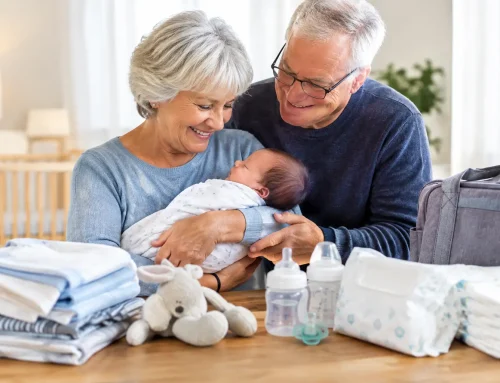
It can also help to let caregivers and relatives handle some everyday care while you are nearby. A grandparent can offer a snack, read a book, or manage a quick post-playground cleanup. For families on the go, having a simple no-rinse option such as Baby Batherz on hand can make messy handoffs, sand, sunscreen, and travel-day grime feel less overwhelming without turning the moment into a full bath routine.
If possible, avoid rushing back in the second your child protests with a safe, familiar caregiver. Give them a chance to be soothed by that person. This is not about ignoring distress. It is about allowing another caring adult to build their own comforting relationship with your child.
What not to expect from yourself or your child
Even the best routine will not prevent every difficult goodbye. Separation anxiety often comes and goes. A baby who was comfortable with a sitter last month may suddenly protest after a cold, a developmental leap, a vacation, or several days of extra togetherness.
You also do not need to force independence before your child is ready. Holding, comforting, and responding to your baby’s cries does not create unhealthy dependence. Secure children gradually learn to explore because they trust that a caring adult is available when they need one.
At the same time, it is okay to keep necessary plans. Parents need work, medical appointments, errands, rest, and time with friends. Leaving your child with a safe caregiver can be part of a healthy family rhythm. The answer is not never separating. It is making separations as predictable, loving, and developmentally appropriate as possible.
When to check in with the pediatrician
Most separation anxiety is normal and improves with time, but trust your instincts if something feels different. Talk with your pediatrician if your child’s distress is intense for many weeks and does not ease after you leave, if it regularly prevents sleep, eating, childcare, or everyday family life, or if your child seems unusually fearful in many settings.
It is also worth asking for guidance if separation anxiety appears alongside developmental concerns, a major behavior change, frequent panic-like symptoms, or signs that your child may not feel safe with a particular person or environment. Your pediatrician can help you sort out what is typical for your child’s age and what may need extra support.
Your baby’s tears at goodbye can tug at every part of you. But each calm, loving reunion teaches a powerful lesson: you can go, they can be cared for, and you always come back.