
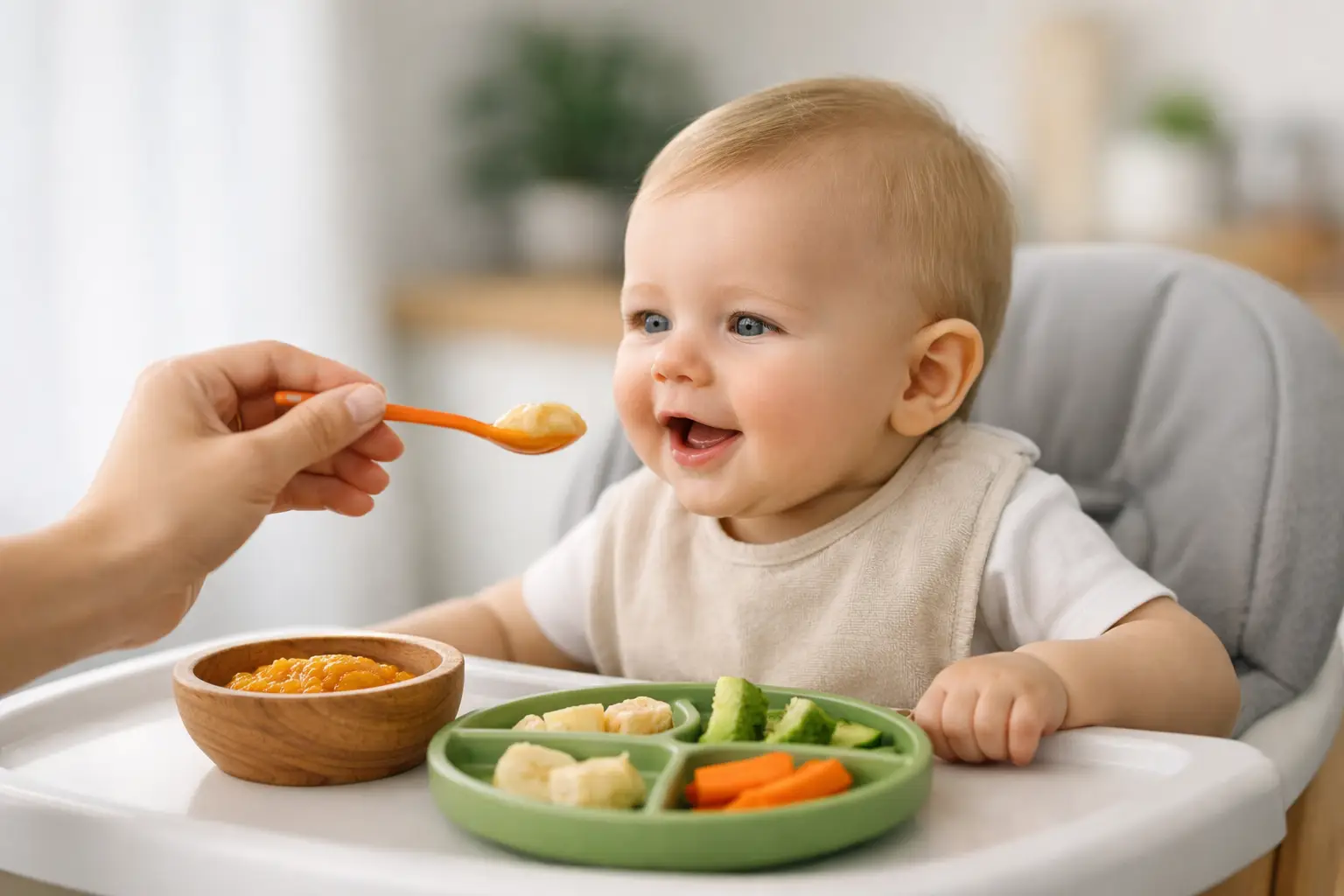
A baby who watches every bite you take can seem more than ready for a taste of dinner. But interest in food is only one piece of the picture. When parents ask about starting solids: how to know when your baby is ready, the most reassuring answer is to look for several developmental signs together, not a single eager reach for your spoon.
For most babies, solids begin around 6 months old. Breast milk or infant formula remains the main source of nutrition through the first year, so there is no prize for starting early or for getting through a full bowl at the first meal. This stage is about safely learning new tastes, textures, and skills – one small, messy bite at a time.
Starting Solids: How to Know When Your Baby Is Ready
Your baby is generally ready to begin solids when they can sit with minimal support and hold their head and neck steady. This matters because safe swallowing starts with stable posture. A baby who is slumped in a seat, leaning far to one side, or unable to keep their head upright needs more time before food beyond milk is offered.
Look for a few signs working together:
- Your baby can sit upright in a high chair with good head and neck control.
- They show interest in food by watching, reaching, or opening their mouth when food approaches.
- They can bring objects to their mouth and move food from the front of the mouth toward the back to swallow.
- The tongue-thrust reflex, which pushes food right back out, has lessened.
Most healthy, full-term babies show these signs close to 6 months. Babies born early may be ready based on their corrected age and individual development, so check with their pediatrician before getting started. If your baby has difficulty swallowing, poor weight gain, low muscle tone, or a medical condition that affects feeding, personalized guidance is especially important.
What does not mean your baby is ready
Waking more often at night, drinking larger bottles, or seeming hungry after a feed does not automatically mean a baby needs solids. Changes in sleep are common in infancy, and starting food does not reliably improve sleep. Likewise, being able to gum a teether does not mean a baby is ready for a meal.
Teeth are not required. Babies can mash many soft foods with their gums. Readiness is about posture, oral-motor control, and safe swallowing – not how many teeth are showing.
Begin with a calm, supported seat
The safest place for early meals is a high chair with a secure harness and a firm, upright 90-degree position at the hips, knees, and ankles when possible. Your baby should never eat reclined in an infant seat, stroller, car seat, or while crawling around the room. Stay within arm’s reach for every bite.
Start when your baby is rested and only mildly hungry, not when they are exhausted or desperately waiting for a bottle. A short meal after a regular breast milk or formula feeding often goes better than trying food when hunger has already turned into tears.
At first, one small meal a day is enough. Offer a teaspoon or two of a smooth puree, or place one or two appropriately prepared soft pieces on the tray if you are taking a baby-led approach. Some babies love a spoon; others want to hold it themselves. Both can be normal, and many families use a mix of spoon-feeding and self-feeding.
Your job is to offer. Your baby’s job is to decide whether and how much to eat. If they turn away, clamp their mouth shut, swipe food away repeatedly, or become upset, end the meal without pressure. A calm finish protects their growing relationship with food.
Choose first foods that bring real nutrition
Choosing Baby’s First Foods
There is no single “perfect” first food. What matters most is gradually introducing a variety of nutrient-rich foods, with special attention to iron and zinc. Around 6 months of age, a baby’s stored iron begins to decrease, making iron-rich complementary foods increasingly important alongside breast milk or infant formula.
Good first foods can include soft, well-cooked meat, finely shredded chicken, mashed beans or lentils, cooked egg, tofu, iron-fortified infant cereal, and appropriately prepared flaky fish. As your baby becomes more comfortable eating, add a variety of fruits, vegetables, full-fat plain yogurt, and soft grains.
You can also begin offering small amounts of water with meals in an open cup or straw cup. At this stage, however, breast milk or infant formula should remain your baby’s primary source of nutrition while solid foods provide new nutrients, flavors, textures, and opportunities to practice eating.
Texture matters, too. Beginning with smooth foods is fine, but staying with only thin purees for too long can make it harder for some babies to learn chewing skills. As your baby manages food safely, gradually move toward thicker mashes, lumpy textures, and soft finger foods. Think ripe avocado, tender sweet potato wedges, soft scrambled egg, or banana spears that are large enough for a baby to grasp.
Introduce common allergens early and carefully
Current pediatric guidance generally supports introducing common allergens in age-appropriate forms once a baby is ready for solids, rather than delaying them. This includes peanut, egg, dairy, wheat, soy, sesame, fish, shellfish, and tree nuts.
The key is safe preparation. Never offer whole nuts, spoonfuls of thick nut butter, or hard chunks of food. Instead, thin smooth peanut or tree-nut butter with water, breast milk, formula, or puree, and offer a small amount. Egg should be fully cooked, and fish should be carefully checked for bones.
Introduce one new allergenic food at a time, preferably earlier in the day when you can observe your baby. Once tolerated, keep it in the regular rotation. Call 911 for trouble breathing, swelling of the tongue or face, widespread hives with vomiting, sudden limpness, or other signs of a severe reaction. For a mild rash, vomiting, or other concerning symptom, stop the food and contact your child’s clinician for advice.
Talk with your pediatrician before introducing peanut or other allergens if your baby has/had severe eczema, a known food allergy, or a prior reaction to food. In those situations, the timing and setting may need to be more individualized.
Know the difference between gagging and choking
Few moments make a parent tense up faster than hearing a baby gag at the table. Gagging is a protective reflex and is common while babies learn to move unfamiliar textures around their mouths. It can be noisy, with coughing, sputtering, or a red face.
Choking is often quiet. A baby may be unable to cough, cry, or breathe, and their skin may begin to look blue or gray. Every caregiver who feeds your child should know infant CPR and choking first aid before solids become a routine.
Avoid foods that are hard, round, sticky, or slippery. Whole grapes, cherry tomatoes, nuts, popcorn, hard raw apple or carrot, chunks of cheese or meat, hot dog rounds, hard candy, and thick globs of nut butter are common choking hazards. Modify foods by cooking until soft, shredding, grating, thinly spreading, or cutting into safe shapes. Cut grapes and cherry tomatoes lengthwise into quarters, not coin-shaped rounds.
Keep milk feeds central and meals low-pressure
In the first months of solids, your baby may swallow very little. That is expected. Breast milk or formula should still come first, and solids gradually become more substantial over time. Do not replace bottles or nursing sessions quickly unless your pediatrician has advised a specific plan.
Avoid honey until after age 1 because of the risk of infant botulism. Skip juice, added sugar, and salty packaged foods. Cow’s milk can be used in small amounts in foods such as oatmeal or mashed potatoes, but it should not replace breast milk or formula as a main drink before age 1.
Mess is part of the learning. A washable bib, a wipeable floor mat, and a clean cloth nearby can make the routine feel much more manageable. For the inevitable oatmeal-in-the-eyebrows or avocado-on-the-high-chair moment, Baby Batherz no-rinse bamboo bathing cloths offer a gentle, fragrance-free way to clean little hands, faces, skin folds, and bodies when a full bath is not practical. Keep them for after-meal cleanup, travel days, or a grandparent’s house – not as a substitute for wiping food from inside the mouth.
When to pause and ask for help
Call your pediatrician if your baby consistently coughs or chokes during meals, seems unable to swallow, vomits often with feeding, refuses nearly all textures after repeated low-pressure practice, or has fewer wet diapers or concerns about growth. Feeding challenges are common, and early support can make meals safer and less stressful.
Starting solids is not a test of your baby’s appetite or your parenting skills. It is a new skill built through repetition, safety, and patience. Settle your baby into their seat, offer one simple food, stay close, and let the small discoveries count.